Showing posts with label Throbbing Gristle. Show all posts

Thursday, October 3, 2013

A Wordship comes a'sailin'


When Cotton Ferox began as an active project in the glorious year of 2000, Thomas Tibert and me had made the decision that we would work together with a diverse bouquet of talents when it came to the vocal contributions. As the first album grew, this also became the case. For First Time Hurts (originally released on CD in 2002), we collaborated with Krister Linder, Michael Moynihan and Genesis Breyer P-Orridge. A powerful mix, to say the least!

The sessions with Genesis turned into seductive lyrics and performances on the tracks Snake Hiss and Amenema. These were, however, basically recordings that were left over from material for our album number 2, Wordship, then already in progress. Not left over in a qualitative sense of course, but definitely in a quantitative one.


Wordship is an album that was made entirely together with Genesis in Stockholm in 2002 (originally released on CD in 2004). There was also a DJ set at Kulturhuset and a sold out lecture at experimental haven/venue Fylkingen, about a legendary career spanning from Coum Transmissions, Throbbing Gristle, Psychick TV and to the then active Thee Majesty. Genesis showed some rare archival footage and I think almost all those present were mind blown to some extent during what turned out to be an amazing evening...


Neil Megson was the person that I was born and named as by my parents, and in 1965 Neil Megson invented a game. He invented a character, Genesis P-Orridge, and he let him loose into the world. In the beginning Neil was being Genesis, and Genesis was responsible for what the Art was and for the creativity, but Neil was the puppet master of this alter ego and he was in control. But then, as Genesis took himself more and more seriously, or as Neil did, he changed his name, and people would meet him and it was only Genesis they were speaking to. And there was no Neil any more. There was a point then when Neil was actually forgotten by Genesis. It’s a strange question that puzzles me now: does Neil still exist? (from the 2002 Stockholm lecture)
Genesis at Studio Konst & Ramar, Stockholm 2002.

Of course we had the previous similar project in memory and mind: At Stockholm, by Genesis Breyer P-Orridge & White Stains (originally released 1990, now available through Highbrow Lowlife). But we wanted it to be different and more modern. If we succeeded or not I leave for today's discerning listeners to decide. But we were happy with the album. We still are.


What made me proud was when someone told me that the album was like nothing she had ever heard before. To me, that's the finest review one can get. Although distinctly in the spoken word-vein, Wordship does manage to transcend the definition and I, at least, feel compelled to just shut down that kind of simplistic genre-jockeying. The long pieces Soul Searching and A Debris Ov Murder are like two very throbbing and hard working gristles, flanked by recurring organic themes and twists, yet always with distinctly different poetries and paces. Genesis' lyrics and the overall performance on this album are still among the finest I've ever heard.


So it is with pride and joy I announce that the album is now available in the digisphere. Listen on Spotify and/or buy where you buy. Please buy from the Highbrow Lowlife web shop if you like (this would make us happy). No matter what, tune in, stay focused, and you will be immersed in a lovely, emotional, haunting, sad, desperate and disparate soul searching megatrip unlike any other. Safe journeys!

Saturday, June 8, 2013

Psychick gig bliss up a head!


Genesis P-Orridge, Gothenburg 1989. © Carl Abrahamsson

It's never too late or too soon to look back and enjoy the past. Especially when it deals with future, as it does now. On June 29th, White Stains will resurface after a 20 year hiatus/hibernation. This in order to celebrate two specific projects: White Stains' 1990 album At Stockholm and Cotton Ferox' album Wordship (2004). Is there a common denominator? Of course. We made these albums together with Genesis Breyer P-Orridge – a living legend if there ever was one.

As we enter the stage at Nefertiti in Gothenburg on the 29th, Genesis will be with us. Not to make specific renditions or versions from our two albums, but rather to encourage and celebrate the atmosphere they contain. Very likely, we will surf on this wave of recurrence/resurgence to make a third album too. It would be stupid not to.

Late 1989, I organised a small spoken word tour for Genesis in Scandinavia. We had also already planned to record some of Gen's readings in a studio setting. As White Stains had just integrated sonic wizard Thomas Tibert, who had his own studio, everything moved on pleasant automatic. Gen read his poems perfectly – most of them were recorded on first takes – and when we later made the music for the poems it was like hand in glove on all levels. With textual material like that and a reading that smooth and professional, it's very hard not to make history.

Other adventures then intervened, as they usually do. But in 2002, it felt like it was high time again. As Genesis was coming over to do a lecture on his work at experimental music centre Fylkingen in Stockholm, Tibert and I prepared new music (then as Cotton Ferox) and it was bliss all over again. The result was released in 2004 in the form of Wordship. Some of these vocal recordings had also been used on Cotton Ferox' debut album First Time Hurts in 2002.

Someone as versatile as Genesis must surely have a hard time with projections from others. Is Genesis an (oc)cultural engineer, an industrial music pioneer, a collage artist, a philosopher, a magician etc? Well, of course, all of these and then some. But there is one all-permeating quintessence that is unmistakeable. Genesis is a poet. This is what fascinated me in the beginning of our friendship, and it still does. That's why it'll be an honour to share the stage with Gen and celebrate his/her poetry and the bizarre music that Tibert and I have concocted over the years. They go well together.

The performance will be neither "industrial" nor "electronica" nor "spoken word" but rather all of it in a colourful and quaquaversal mix created to make emotional jump cuts and possible existential mutations. It will be a grand old time spanning from ancient history to the distant future. I hope you'll be there together with us at Nefertiti in Gothenburg on June 29th, 2013, on this exciting adventure.


PS. You can buy all of the above albums at the iTunes Music Store. By buying the albums instead of illegally downloading them, you help us in the process of making and releasing new music. Thank you.

I should also mention that the concert is the public final event of a four day conference/symposium at the University of Gothenburg dealing with esotericism, occultism, alternative health movements and many other interesting things. Please consider taking part in this too!


"In the beginning there were White Stains." (Genesis 23:1)

Friday, February 22, 2013

Re-inventing a square wheel?


Swedish label Kning Disk are renowned for their high quality special editions of works of art jam-packed with integrity and vision. A recent release, Tingens Vilja, further cements their position as a central space for truly unique and beautiful expressions.

Tingens Vilja is a nice little cardboard box containing two CDs and several printed cards. All of it produced jointly by Alexandra E Lindh and Dan Fröberg. The initial impression is one of meticulous diligence. Although apparently flirting with chance and discarding apparent order and structure, there is still an almost anal retentive vibe in the assemblage of the pieces. It’s very neatly and well put together.

The same goes for the very core of Tingens Vilja: the sounds. Although highly collage-based and free-flowing inbetween styles and sounds, there is an easily discernable supra-order involved that I guess could be termed the "soul" or glue of the totality.

Tingens Vilja is a beautiful work of art. That Dan Fröberg is a superb Klang Meister we already know from earlier projects. Together with Lindh, whose piano sections add a forceful fragility to the overall impressions, Fröberg concocts a sensuous and seductive trip through a vast array of emotions – mostly quite dark ones. It’s a teamwork that belongs in another, higher state of consciousness.

When I listen though, I know approximately what to expect, and I can't imagine that's the idea. Perhaps this kind of assembled sound art containing a collage modus operandi has actually become a quite conservative and predictable approach? Or perhaps I’m just jaded from having listened to too much experimental music?

There’s a zither, there’s nature, ambient sounds, Glockenspiele, birds, loosely lo-fied voices, atonal attempts, tonal tendernesses, hiss, noise, silence, electronic scapes and many other things in a very poetic and intuitive assembly. Lindh’s piano becomes a very human meme within this midst of subtle cacophony. Its (reverbed) distance makes it sound nostalgic in a way – like listening in on someone’s emotional past. This is intelligent structuring, like buoys in a deep sea of fairly well-known audio art tricks. Had this been done in a less sensitive manner, the entire project could easily have become too predictable, like someone trying to re-invent a square wheel in order to be different from all the other square wheel-makers (the ghosts of Subotnick, Throbbing Gristle, et al).

The packaging is very nice indeed, with its cards of equally nostalgic-emotional images from someone’s past. In all, it’s a looking back (?) into a timeless zone. One listens to the emo-ride of aural mementoes and at the same time it’s absolutely possible to play exactly that – spontaneous Memento – with the enclosed images. No rules, no co-players, just you and your emotional response to the audio-visual input.

Tingens Vilja means ”The Will of the Things”, and I can’t really tell whether this box is a pro- or contra stance. Do things really have a will? It doesn’t matter though. What matters is the ride through this psychic forest and the box as such provides pretty solid boots. It’s an enjoyable trek but, as often within forests, certain passages are eerie and haunted. Tingens Vilja is no exception.

This project is a joint release with the amazing antiquarian bookstore Rönnells in Stockholm, a place you really have to visit when in town. Or visit very often if you are a Stockholm resident. Simple as that.


Tuesday, January 29, 2013

The Best Album Ever?


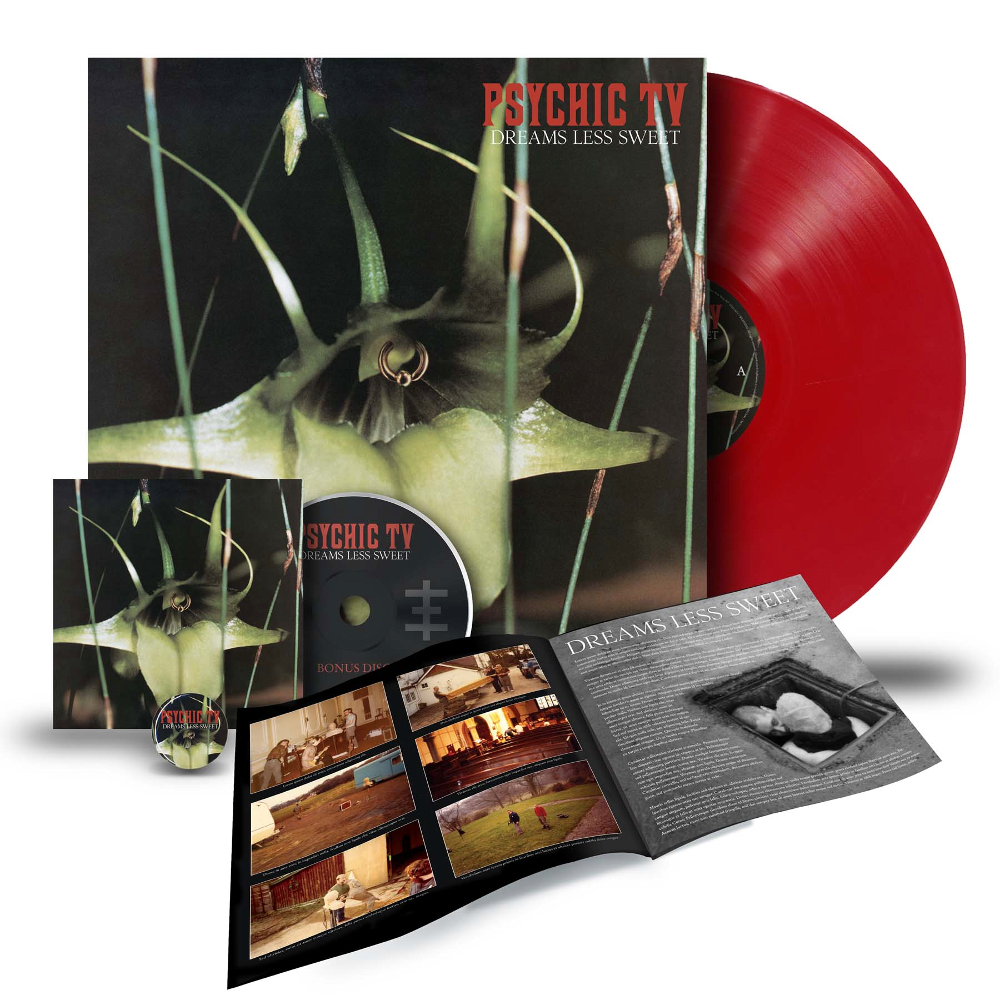
The recent re-release on vinyl of Psychic TV’s 1983 album Dreams Less Sweet has made me ponder one of those very important questions in life… Could it be that this is actually the best album ever made? The more I listen to it, the more convinced I get.

In general, I’m conservative in terms of taste and it’s been very hard for me to realise that The Stooges’ Funhouse or Rolling Stones’ Exile on Main Street perhaps no longer fill the emotional voids of yesteryear. I can still enjoy them, and occasionally do, but not in the same compensatory way like when I was 15. But that is merely a personal perspective of course. Life changes. Musical tastes change with it.

Which albums are still flawless on every level 30 years after their release? Well, those two rock’n’roll classics certainly are, I’d say (and then we’re talking more than 40 years!). Probably a few others. But if we zoom back to 1983, what was going on that still remains fresh and interesting today? Not much, right?

Throbbing Gristle had already re-created or corrupted the concept of an album and made the experience as much an intellectual merry-go-round as a sensual one. Although existentially dark and steeped in harsh, late 70s UK life, TG brought revelation upon revelation to the generation that wasn’t satisfied with merely the three chord simplicity of punk. Not only was an element of intellectual adventure brought in. The very idea or concept of what an album could actually be was dropped like a smart bomb in the cesspool of clever and self-indulgent nihilism of the era.

This openmindedness in structure and magical planting was developed further on Psychic TV’s debut album Force the Hand of Chance (1982), but only to a degree. The focus here seemed to be to corrupt expectations post-TG more than anything else. Soft-sung pop ballads and quite conventional music surely made some die-hard TG fans twitch, but in general it was a pleasant new direction.

If Force the Hand of Chance was the smooth antithesis to TG in general, then the synthesis that followed turned out in every way perfect. Dreams Less Sweet is so well balanced in its content and form, so imbued with overt messages and esoteric secrets, so intricate in its concoctions and so simple in its totality that I fail to find a similarly perfect album.

If we stick to the non-postmodern approach first, ie rub off all the programmatic raisons d’être and just leave it to the ears (preferably snugly stuck in good headphones), we are sucked in by a church organ and into a serene… The Orchids… What a masterpiece! Genesis P-Orridge’s frail voice and exquisite lyrics are matched by a simple orchestral arrangement, with oboe and marimbas. How unlikely was that arrangement at the time?

On to Botanica, with violent drumming and musique concrète elements, sliding into Iron Glove, an almost Morriconesque backing track to a recorded telephone poem (read by TG- and PTV-collaborator Monte Cazazza)… Always is Always Forever, a choral ”arrangement” for solo voice, followed by a 60s-inspired pop ballad, White Nights, again centered around P-Orridge’s voice in a mi(d)st of Beach Boys vibes. Followed by another high contrast twist, Finale, with machine guns, fire, snarling dogs and martial trumpets.

Eleusis is another vocal piece, with added percussive glass-like elements, perhaps to accentuate frailty in power or vice versa. Medmenham brings in forceful Tibetan Thighbone trumpets, seductively swirling in stereo. Ancient Lights: a collage of vocals, telephones, traffic sounds, karate instructions and more. Proof on Survival…”Do not be deterred by little results… Persevere…” (with sounds of someone being buried, in this case the microphonic head called ”Ringo”)

Eden 1: A frenzied telephone collage turns into experimental minimalist ”rock”… And tattooing sounds… Eden 2: More chorals… Eden 3: TG-sounding aggression, soon to be pleasantly contrasted by Clouds without Water… The soundtrack to a 1920s stroll on the English counryside…? Black Moon sounds like Lou Reedish basic pop…”The little boy, a living ghost…”

Silver and Gold: Ethereal Tibetan singing bowls… Followed by the ”smash hit” (in the literal sense) In the Nursery… Inner spiritual visions recounted to violent music…”Without is without in the nursery…”

Circle ends the album… A single flute in emotional farewells, actually bordering on the sentimental… Not so much "El Condor Pasa" but perhaps "El Condom Plaza"…? Because when the music’s over and the album’s over your mind has truly and genuinely been boinked, severely and pleasantly so.

If we jump back on the postmodern bandwagon and take a look at what’s there on the programmatic level, we find a multitude of references that further thickens and makes potent the already beautiful structure. Always is Always Forever is the classic Manson Family song, here revamped into high seriousness. Clouds without Water is the title of an Aleister Crowley book from 1909. The emotional tone of Crowley’s poems surely resonates well with Dreams Less Sweet:

”All hope of life even from the rare sad seeds
It blows from sunnier vales and happier hills,
Though at best they be but worthless weeds.
I stand – I scan the infinite horizon
Of hopeless hope – yet I must travel on.”

(Clouds without Water, ”The Hermit”)

Medmenham was the place where Sir Francis Dashwood gathered his acolytes in the caves of his infamous Hell Fire Club. Incidentally the same caves where the Tibetan singing bowls of Silver and Gold were recorded.

The sounds of ”Mr Sebastian” (a pioneer of genital and other kinds of piercing in the UK) tattooing a young Geoff Rushton/Jhon Balance. Eleusis, the initiatory environment/temple in ancient Greece that allowed its chosen few to see beyond the veil of ordinary life, very likely through hallucinogenics. The ”Nursery” was the term for the ritual space/temple of the PTV related order/group Thee Temple Ov Psychick Youth. Burroughs-references are here too (and Burroughs’ ”second mind” Brion Gysin is thanked in the sleeve notes). And everything was recorded with ”holophonic” sound, an Ersatz kind of stereo that does indeed create quite an eerie presence (as mentioned before, listen in headphones). Et cetera.

In all, the form and the content add up to a shockingly wealthy impression of sub- and occultural magnificence. It’s not an ”experimental” album. It’s not a haphazard attempt at being clever either. It’s truly a sui generis piece of art that just happened to manifest in sounds and words. A journal of inner experimentation, an invaluable example of artistic courage.

Yes, now I can see (and hear) it clearly: Dreams Less Sweet is indeed my favourite album. Whether it's the best one ever, I leave to you to decide.