Showing posts with label William Burroughs. Show all posts

Saturday, January 25, 2014

The uncommon sense of nonsense


"Do you remember how, when we were children, we'd leaf through picture books and, pretending we could read before the children older than us, fantasize about the images we saw there? Who knows, I thought to myself, perhaps unintelligible and alien writing could make us all free to once again experience those hazy childhood sensations. At the time, the quest for this new alphabet seemed to me to be the most urgent thing that had to be done." (Luigi Serafini)

So, finally, Luigi Serafini's masterpiece Codex Seraphinianus has recently been re-published by Rizzoli. This masterpiece of creative imagination has never been surpassed since its latest release in 1981. There is simply no other book like it. I don't think there ever will be either.

On page after page we can study exquisite color pencil drawings of weird warps of perception made by Italian architect, artist and designer Serafini between 1976 and 1978. Figurative beauty melts away into grotesqueries, ordinary things are rearranged into extraordinary, perspectives are skewed and screwed, colors are saturated to enhance extra dimensions... Hundreds of drawings get stuck in your mind, which reacts to each single one with a flashing question mark and a soft tilt of the entire perceptive system.

Close by the literally incredible drawings are writings in a language and alphabet entirely of Serafini's own making. It's a beautiful script which makes perfect sense in its own way. Of course, one becomes curious... What does it say? What is the meaning? But those kinds of petit-bourgeois angles become redundant already on page one. There is nothing to be understood here. Or everything. You can decide for yourself (I hope).


The mysterious impressions of such an ambitious project naturally got metaphysical problem-solvers started already after the first editions of the book... Is there perhaps a code in the Codex? Is there a hidden meaning? Comparisons with the Voynich Manuscript of the 15th century have been made, and speculations have been overflowing... In comparing the two as phenomena rather than as single books, it's not unlikely that Serafini has been inspired by the Voynich Manuscript. But that in itself says nothing of coherence or meaning in either volume. Which is probably a good thing.

Serafini himself discloses some of the genesis of the project in a booklet called Decodex (included in the book). As a 27 year old artist, he was making drawings of humans with strange prostheses and realized he needed some texts and captions to go with them. To get back to the childlike fascination and amazement when flipping through encyclopedias, he simply made up his own.

The idea is of course interesting. The execution is that of a master's. But, let's not forget that he himself also ascribes many of the ideas for both drawings and letters/sentences to a stray white cat that he took in at his apartment in Rome. The symbiosis with the cat was apparently instrumental in the creation of the book. Echoes of Lovecraft and Burroughs, anyone?

Petty provocations create petty responses. But a book such as Serafini's, besides being a truly magnificent work of art, is a penetrating provocation on so many sophisticated and subtle levels that I wouldn't hesitate to call it almost "corrupting". Not in any essentially "moral" way, but simply in how it so elegantly draws you into a world overwhelmingly alluring and attractive, yet also completely coercive and persuading in its relentless energy. It's very hard to leave the Codex Seraphinianus once you're inside. And why would one want to leave this remarkable universe?


In terms of creative mania, perhaps one could compare Serafini with Henry Darger or similar more pathological artists. But the comparison stops there, in the intensity and devotion to a massive and more or less incomprehensive oeuvre. Where Darger's legacy left us/the art world with a million pathetic and slackered infantilists, regurgitating the same baby-noir mannerisms over and over, Serafini's work is like a Leonardo da Vinci's for the imminent apocalypse.

He delves through flora, fauna, technology, the human being, construction, engineering and fantasy in an inimitable way – he might as well have illustrated a "real" flora and would have done a great job at it.


This brilliant perversion of figurative skill is the very essence of the art of the 21st century that will be deemed valuable in the future. Valuable, as in carrying an "impact", and not necessarily based on monetary worth. The more upheavals of the anticipated, the greater the possibility of healthy mutations in a stagnant, entropic western culture. Serafini is a master not only on detail level (each drawing, each sentence) but also on the bigger one (the book in itself is an artwork: an encyclopedia for those who strive to know everything and nothing in new ways). This psychedelic Magnum Opus stirs and jolts the sedated minds of complacent art consumers in ways that can perhaps (hopingly) open the door to a more vital sense of humor and wit on general levels.

So, what is it? Mere mind games in the tradition of Marcel Duchamp and other pun-driven brainiacs? Trip art for armchair psychonauts? Surrealism taken to a contemporary level? A nonsensical mockery of the rational? A celebration of human ingenuity taken out of utilitarian context? The questions are basically as many as there are pages in the book. And of course they don't have to be answered at all. Perhaps they shouldn't? It's quite enough to just enjoy the book. Let the images sink in and who knows...? Perhaps you too will morph into a new kind of being stemming from the pen and genius of Luigi Serafini?


Luigi Serafini: Codex Seraphinianus, Rizzoli, 2013.


Wednesday, December 25, 2013

Breyer P-Orridge: the quality of quantity!


Who ever said that quantity is not a quality? The past months' veritable floodgate of Breyer P-Orridge-related material deserves a closer look. Or are you perhaps already aware of all of these things?


The publishing of First Third's monumental memory lane volume Genesis Breyer P-Orridge, containing hundreds of images of Genesis in formal transition over the decades, is an impressive feat. Not only is the project as such highly interesting and revealing (transition and morphing being one of Genesis' main tools of the artistic trade). It's also such a beauty of a book, with standards of production worthy of a Steidl, Rizzoli or Taschen. The underground in an overground package, so to speak. Mind boggling stuff!


Dais Records in New York recently released an LP with COUM Transmissions. This isn't all music per se but recorded sounds from the COUM era. It's a nice release, and a must have for completists of course (read: Industrial Culture philatelists). Here's what Dais writes:

"The most recent installment of the rare & unheard archival recordings from the transgressive 70′s performance art group COUM Transmissions. Founded in late 1969 by Genesis P-Orridge, COUM Transmissions’s provocative performances mixed with visual art solidified the group as one of the most forward thinking breakthroughs within the 70′s conceptual art scene. Only in the past couple years has COUM’s recorded works seen the light of day. This release collects various selections spanning the years 1971 through 1975, including a rare live performance opening for Hawkwind, lost radio interview, obtuse poetry readings by early member Fizzey Peat, piano & violin compositions by Genesis P-Orridge and insightful field recordings. Limited to 1,000 vinyl copies."


Space Rock outfit PTV3 have also been diligent and at it recently, playing live and recording. Angry Love has released some inspired neo-Hawkwindean sounds that takes you to the bright side of the moons and back. Who'd ever thought that the P-Orridgean beatnik existentialism of yesteryear could house the seeds of Krautish riffing? No matter what, far out it is. And sounds.

Cold Spring have recently re-issued several Psychic TV concerts from the 1980s and 90s on CD. I've lost count of these, sorry. See for yourself at Cold Spring's website. Available there is also the highly recommended Psychic TV Themes box set of CDs. For a review of that, please see my blog post from July 2nd, 2012.

My own little digi-label endeavor with Thomas Tibert, Highbrow Lowlife, has also contributed to the avalanche. We have been active for four months now, and there are several GBPO-related releases in our budding catalog of aural adventures: The EP I Travel, some tracks on Cotton Ferox' debut album First Time Hurts and, most importantly, the full on collaboration between Genesis and Cotton Ferox in the album Wordship. Available now at Highbrow Lowlife's own web store. And available in many other places too, including streaming on Spotify and similar services.

A documentary film about Genesis in the An Art Apart-series is in the works. It's produced by yours truly together with the magnificent production team AMP, and so far we have shot material with Genesis in Stockholm, Gothenburg and New York. We aim to have this film ready by the end of 2014.


Another memory lane trip is the slim but interesting volume G.P.O. vs G.P-O., being a collection of reproduced documents from the infamous court case in 1976. This is a nice 2013 facsimile edition from Primary Information of the original 1976 Ecart volume. The case was the sensational one when Genesis was charged with sending "indecent" postcards/collages through the UK mail system (GPO=General Post Office). With a little help and support from William Burroughs and other friends, Genesis got away with a fine. And material for this compendium. Interesting to read as a document from an era of UK governmental oppression very hard to fathom today. 

For more "porridge with everything", please have a look at www.genesisbreyerporridge.com


Tuesday, January 29, 2013

The Best Album Ever?


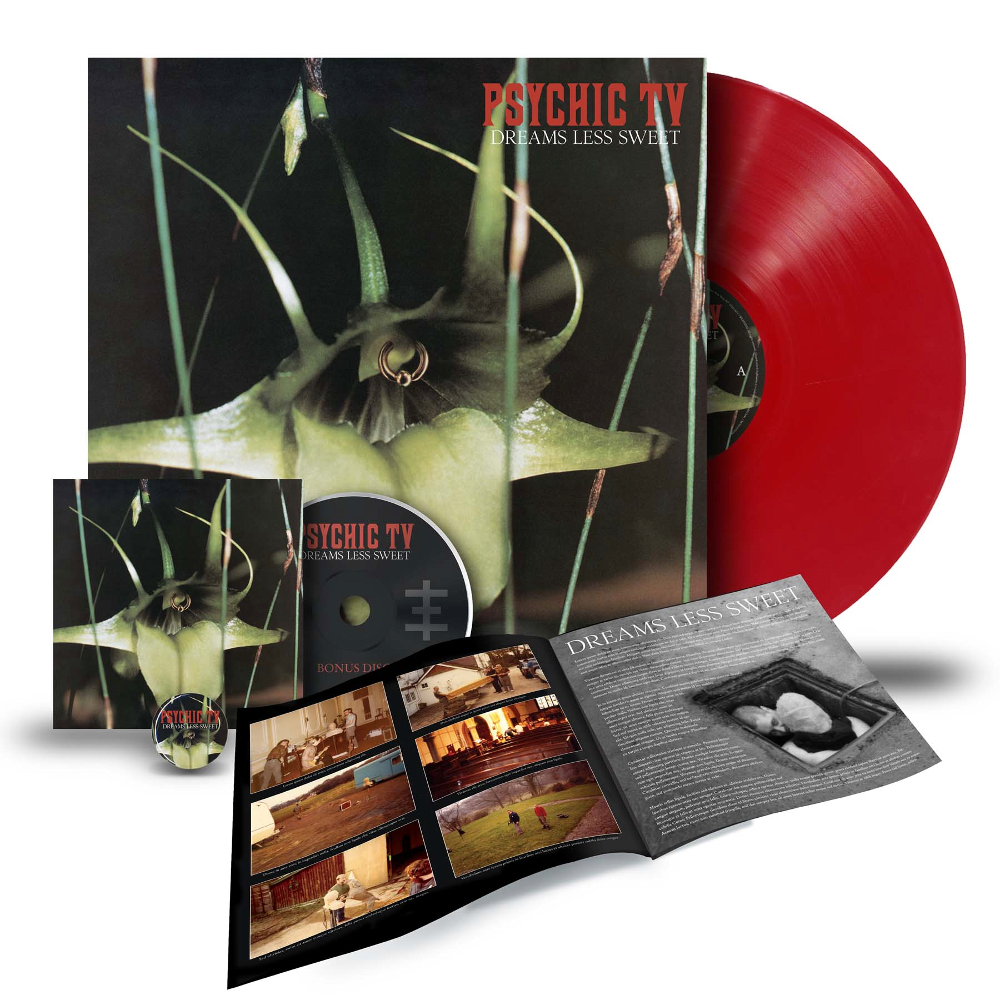
The recent re-release on vinyl of Psychic TV’s 1983 album Dreams Less Sweet has made me ponder one of those very important questions in life… Could it be that this is actually the best album ever made? The more I listen to it, the more convinced I get.

In general, I’m conservative in terms of taste and it’s been very hard for me to realise that The Stooges’ Funhouse or Rolling Stones’ Exile on Main Street perhaps no longer fill the emotional voids of yesteryear. I can still enjoy them, and occasionally do, but not in the same compensatory way like when I was 15. But that is merely a personal perspective of course. Life changes. Musical tastes change with it.

Which albums are still flawless on every level 30 years after their release? Well, those two rock’n’roll classics certainly are, I’d say (and then we’re talking more than 40 years!). Probably a few others. But if we zoom back to 1983, what was going on that still remains fresh and interesting today? Not much, right?

Throbbing Gristle had already re-created or corrupted the concept of an album and made the experience as much an intellectual merry-go-round as a sensual one. Although existentially dark and steeped in harsh, late 70s UK life, TG brought revelation upon revelation to the generation that wasn’t satisfied with merely the three chord simplicity of punk. Not only was an element of intellectual adventure brought in. The very idea or concept of what an album could actually be was dropped like a smart bomb in the cesspool of clever and self-indulgent nihilism of the era.

This openmindedness in structure and magical planting was developed further on Psychic TV’s debut album Force the Hand of Chance (1982), but only to a degree. The focus here seemed to be to corrupt expectations post-TG more than anything else. Soft-sung pop ballads and quite conventional music surely made some die-hard TG fans twitch, but in general it was a pleasant new direction.

If Force the Hand of Chance was the smooth antithesis to TG in general, then the synthesis that followed turned out in every way perfect. Dreams Less Sweet is so well balanced in its content and form, so imbued with overt messages and esoteric secrets, so intricate in its concoctions and so simple in its totality that I fail to find a similarly perfect album.

If we stick to the non-postmodern approach first, ie rub off all the programmatic raisons d’être and just leave it to the ears (preferably snugly stuck in good headphones), we are sucked in by a church organ and into a serene… The Orchids… What a masterpiece! Genesis P-Orridge’s frail voice and exquisite lyrics are matched by a simple orchestral arrangement, with oboe and marimbas. How unlikely was that arrangement at the time?

On to Botanica, with violent drumming and musique concrète elements, sliding into Iron Glove, an almost Morriconesque backing track to a recorded telephone poem (read by TG- and PTV-collaborator Monte Cazazza)… Always is Always Forever, a choral ”arrangement” for solo voice, followed by a 60s-inspired pop ballad, White Nights, again centered around P-Orridge’s voice in a mi(d)st of Beach Boys vibes. Followed by another high contrast twist, Finale, with machine guns, fire, snarling dogs and martial trumpets.

Eleusis is another vocal piece, with added percussive glass-like elements, perhaps to accentuate frailty in power or vice versa. Medmenham brings in forceful Tibetan Thighbone trumpets, seductively swirling in stereo. Ancient Lights: a collage of vocals, telephones, traffic sounds, karate instructions and more. Proof on Survival…”Do not be deterred by little results… Persevere…” (with sounds of someone being buried, in this case the microphonic head called ”Ringo”)

Eden 1: A frenzied telephone collage turns into experimental minimalist ”rock”… And tattooing sounds… Eden 2: More chorals… Eden 3: TG-sounding aggression, soon to be pleasantly contrasted by Clouds without Water… The soundtrack to a 1920s stroll on the English counryside…? Black Moon sounds like Lou Reedish basic pop…”The little boy, a living ghost…”

Silver and Gold: Ethereal Tibetan singing bowls… Followed by the ”smash hit” (in the literal sense) In the Nursery… Inner spiritual visions recounted to violent music…”Without is without in the nursery…”

Circle ends the album… A single flute in emotional farewells, actually bordering on the sentimental… Not so much "El Condor Pasa" but perhaps "El Condom Plaza"…? Because when the music’s over and the album’s over your mind has truly and genuinely been boinked, severely and pleasantly so.

If we jump back on the postmodern bandwagon and take a look at what’s there on the programmatic level, we find a multitude of references that further thickens and makes potent the already beautiful structure. Always is Always Forever is the classic Manson Family song, here revamped into high seriousness. Clouds without Water is the title of an Aleister Crowley book from 1909. The emotional tone of Crowley’s poems surely resonates well with Dreams Less Sweet:

”All hope of life even from the rare sad seeds
It blows from sunnier vales and happier hills,
Though at best they be but worthless weeds.
I stand – I scan the infinite horizon
Of hopeless hope – yet I must travel on.”

(Clouds without Water, ”The Hermit”)

Medmenham was the place where Sir Francis Dashwood gathered his acolytes in the caves of his infamous Hell Fire Club. Incidentally the same caves where the Tibetan singing bowls of Silver and Gold were recorded.

The sounds of ”Mr Sebastian” (a pioneer of genital and other kinds of piercing in the UK) tattooing a young Geoff Rushton/Jhon Balance. Eleusis, the initiatory environment/temple in ancient Greece that allowed its chosen few to see beyond the veil of ordinary life, very likely through hallucinogenics. The ”Nursery” was the term for the ritual space/temple of the PTV related order/group Thee Temple Ov Psychick Youth. Burroughs-references are here too (and Burroughs’ ”second mind” Brion Gysin is thanked in the sleeve notes). And everything was recorded with ”holophonic” sound, an Ersatz kind of stereo that does indeed create quite an eerie presence (as mentioned before, listen in headphones). Et cetera.

In all, the form and the content add up to a shockingly wealthy impression of sub- and occultural magnificence. It’s not an ”experimental” album. It’s not a haphazard attempt at being clever either. It’s truly a sui generis piece of art that just happened to manifest in sounds and words. A journal of inner experimentation, an invaluable example of artistic courage.

Yes, now I can see (and hear) it clearly: Dreams Less Sweet is indeed my favourite album. Whether it's the best one ever, I leave to you to decide.